


Severity
High
Analysis Summary
The Nasir Security group, also known as the Nasir Resistance, has claimed responsibility for a significant cyber intrusion targeting Dubai International Airport (DXB), one of the world’s busiest and most critical aviation hubs. According to their public statements, the group alleges it has maintained persistent and undetected access to the airport’s internal and classified systems for several months.
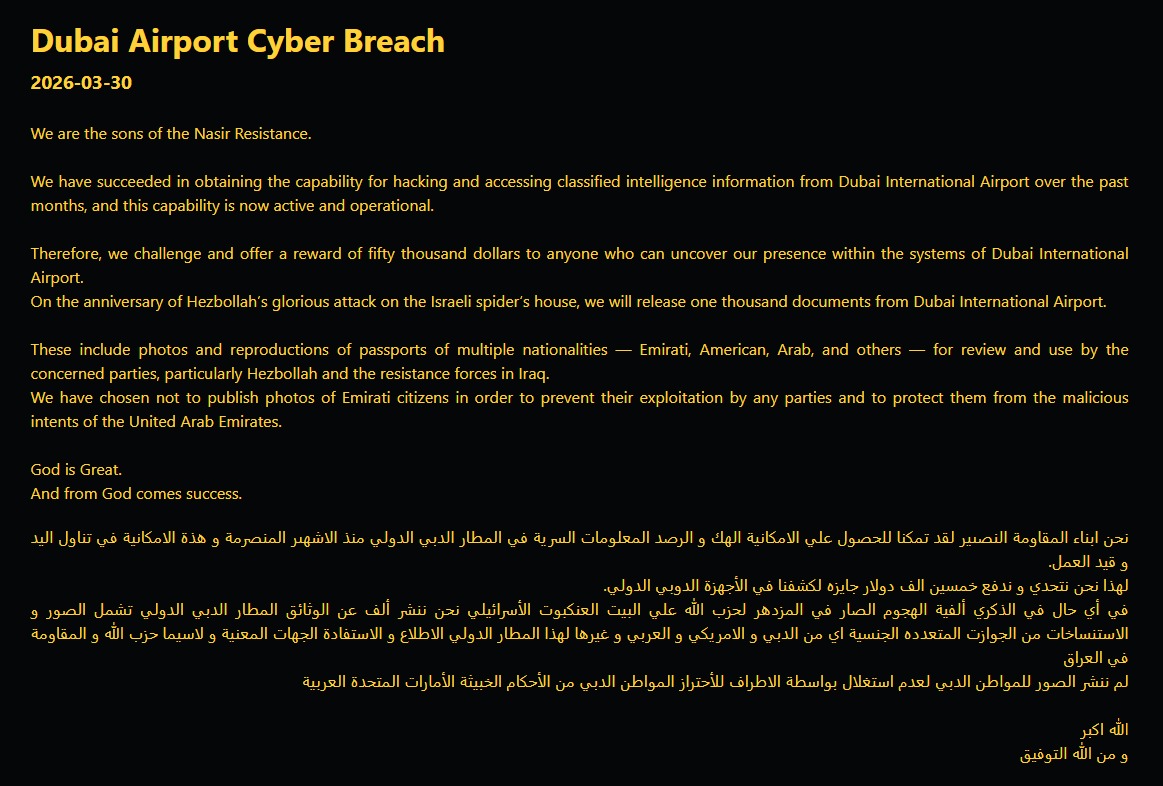
The group portrays the operation as part of a broader hacktivist campaign aligned with geopolitical motives. To reinforce their claim, they issued a public challenge offering $50,000 to anyone capable of identifying their presence within the compromised network—suggesting a high level of confidence in their stealth and persistence.
Nasir Security claims to have exfiltrated a range of sensitive data, including classified intelligence materials and approximately 1,000 internal documents. Additionally, they allege possession of passport images and reproductions belonging to individuals from multiple nationalities, including American and Arab citizens. If verified, such data exposure could raise serious concerns regarding privacy, identity theft, and national security.

The group has further threatened to release the stolen information to support specific geopolitical resistance factions, indicating a potential escalation from data theft to information warfare. At this stage, the claims remain unverified by official authorities, and no formal confirmation has been issued by airport officials or relevant government bodies.
If true, this incident would represent a major breach in critical infrastructure security, highlighting ongoing risks posed by politically motivated cyber actors targeting global transportation systems.
Impact
- Data Exfiltration
- Unauthorized Access
- Sensitive Information Theft
Remediation
- Conduct full incident response and forensic investigation to identify scope, entry point, and attacker activity
- Isolate affected systems immediately to prevent further lateral movement and data exfiltration
- Revoke and reset all compromised credentials, including privileged and service accounts
- Deploy network segmentation to limit access between critical and non-critical systems
- Implement continuous monitoring and threat hunting to detect persistence mechanisms
- Patch and update all vulnerable systems, applications, and security appliances
- Enforce multi-factor authentication (MFA) across all critical systems and remote access points
- Validate integrity of systems and restore from clean, secure backups where necessary
- Strengthen endpoint detection and response (EDR) capabilities for real-time threat visibility
- Review and harden access controls based on least privilege principles
- Conduct security awareness and phishing training for staff to reduce human risk
- Engage external cybersecurity experts or CERT for independent validation and support
- Notify relevant authorities and comply with regulatory reporting requirements
- Monitor dark web and threat intelligence sources for potential data leaks
- Develop and test an improved incident response and crisis communication plan