

Severity
High
Analysis Summary
A new variant of the Poco RAT malware, linked to the cyber-mercenary group Dark Caracal, has emerged as a major cyber threat to Spanish-speaking organizations in Latin America. This campaign leverages phishing emails disguised as financial notifications, using PDF decoys mimicking Venezuelan banks and industrial firms to lure victims. These PDFs redirect users to shortened URLs hosting malicious .rev archives on cloud platforms like Google Drive and Dropbox. By exploiting the trust in legitimate services, attackers evade detection, with only 7% of decoy documents triggering antivirus alerts. The Poco RAT dropper, a Delphi-based executable, injects itself directly into processes like iexplore.exe to avoid leaving traces on disk.
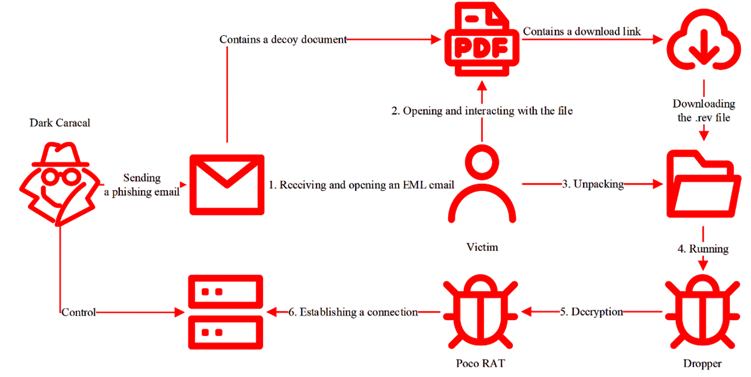
Dark Caracal has introduced sophisticated evasion techniques in this campaign, such as dynamic API resolution, Twofish encryption with per-build keys, and exception-handler hijacking to bypass security tools. The attack scope has expanded, with 49% of recent phishing attempts targeting technology firms, a 33% increase from 2023. Financial organizations and manufacturing enterprises remain key targets, reflecting the group's continued focus on financial espionage and intellectual property theft. This shift in targeting shows Dark Caracal’s evolving tactics beyond their earlier Bandook RAT operations.
Once Poco RAT is deployed, it performs extensive reconnaissance, including virtualization detection through registry checks and port scanning. It collects system details such as usernames, OS versions, and RAM metrics, formatting them into structured reports. The malware communicates with its command-and-control (C2) infrastructure using heartbeat messages to IPs like 193.233.203.63 while cycling through ports 6211–6543 to evade network-based defenses. Key capabilities include screen capture (T-05), fileless payload execution (T-03), and passthrough command prompt access (T-06), enabling attackers to maintain deep persistence within compromised networks.
Infrastructure analysis by the Researcher reveals strong overlaps between Poco RAT and Bandook operations, with both malware families using the same hosting providers. AS200019 (AlexHost SRL) hosts Poco RAT (185.216.68.121) alongside Bandook C2 servers (185.216.68.143), while AS44477 (Stark Industries Ltd.) has served both campaigns since 2023. With Poco RAT infections rising by 36% year-over-year, this attack highlights the growing sophistication of Dark Caracal’s methods. To counter these threats, organizations must implement defense-in-depth strategies, combining advanced technical controls with rigorous user awareness training to mitigate phishing risks and cloud abuse tactics.
Impact
- Security Bypass
- Sensitive Data Theft
- Financial Loss
Indicators of Compromise
IP
185.10.68.52
45.67.34.219
77.91.100.237
94.131.119.126
185.216.68.121
MD5
a5073df86767ece0483da0316d66c15c
2a0f523b9e52890105ec6fbccd207dcd
e0bf0aee954fd97457b28c9233253b0a
bbfbd1ece4f4aa43d0c68a32d92b17e5
a2ea38d11bde2a4483b86321960d6319
a12d326845a96a03867b2b70ca8f12ee
SHA-256
05bf7db7debfeb56702ef1b421a336d8431c3f7334187d2ccd6ba34816a3fd5a
08552f588eafceb0fa3117c99a0059fd06882a36cc162a01575926736d4a80eb
0d6822c93cb78ad0d2ad34ba9057a6c9de8784f55caa6a8d8af77fed00f0da0a
1786f16a50a4255df8aa32f2e21f2829b4f8aaba2ced3e4a7670846205b3ac70
01e8536751080ea135c3ad7ae9187d06cdcccddfc89bc0d41ea4281eeb3e9fb4
21ff46a6fc9173fcc147d7a5c603032c662c6c1f1b05c1bb1e30e20e168bb056
SHA1
d0661df945e8e36aa78472d4b60e181769a3f23b
f3a495225dc34cdeba579fb0152e4ccba2e0ad42
ce611811d9200613c1a1083e683faec5187a9280
2ffdf164f6b8e2e403a86bd4d0f6260bf17fb154
5240860d0db91bd8e13a150676a3ab1917312c59
3b1264d2e156a09142847b6a18f70a3267c406e2
Remediation
- Block all threat indicators at your respective controls.
- Search for indicators of compromise (IOCs) in your environment utilizing your respective security controls.
- Train employees to recognize phishing attempts, especially financial-themed lures.
- Implement email filtering to block suspicious attachments and links.
- Use DMARC, DKIM, and SPF records to prevent email spoofing.
- Deploy endpoint detection and response (EDR) solutions to identify and block suspicious behavior.
- Use application whitelisting to prevent unauthorized execution of files like rev archives.
- Monitor process injection attempts, particularly into iexplore.exe or similar processes.
- Restrict access to cloud storage services if not required for business operations.
- Use web filtering to block access to known malicious URLs and domains.
- Monitor outbound traffic for unusual connections to C2 IPs like 193.233.203.63 and ports 6211–6543.
- Ensure regular backups of critical data and store them offline.
- Keep antivirus and anti-malware solutions updated to detect evolving threats.
- Encrypt sensitive files to limit data exposure in case of a breach.
- Patch operating systems and software regularly to close security vulnerabilities.
- Disable execution of scripts and macros from untrusted sources.
- Implement network segmentation to limit lateral movement in case of an infection.
- Set up centralized logging to detect early signs of compromise.
- Conduct regular threat-hunting exercises to identify hidden threats.
- Develop an incident response plan to contain and remediate infections quickly.