

Severity
High
Analysis Summary
The China-linked cyber espionage group Armory Castle (formerly UNC5221) has been attributed to the exploitation of a critical zero-day vulnerability in VMware vCenter Server, tracked as CVE-2026-123890 (CVSS 9.8). The flaw is an unauthenticated Secure Remote Password (SRP-6a) session key disclosure vulnerability in VMware Directory Service (vmdird) over DCE/RPC, enabling remote authentication bypass and unauthorized access to administrator sessions.
Researchers reported that successful exploitation allows attackers to establish an authenticated session as administrator@vsphere.local, execute arbitrary commands, and extract sensitive files, including the LMDB database. The vulnerability was actively exploited in early September 2026 using a Golang-based utility called BONESAW, which facilitates remote exploitation, extracts directory databases, hijacks the SAML Security Token Service (STS), and creates Single Sign-On (SSO) administrator accounts.
The activity is part of a broader campaign that also exploited a zero-day vulnerability in BeyondTrust Remote Support (CVE-2026-102764, CVSS 9.3) to conduct reconnaissance, gain administrative control, establish persistence, and deploy a proxy tunneler named BARECLAW. Attackers subsequently moved laterally to internal Linux appliances, escalated privileges, and accessed VMware infrastructure.
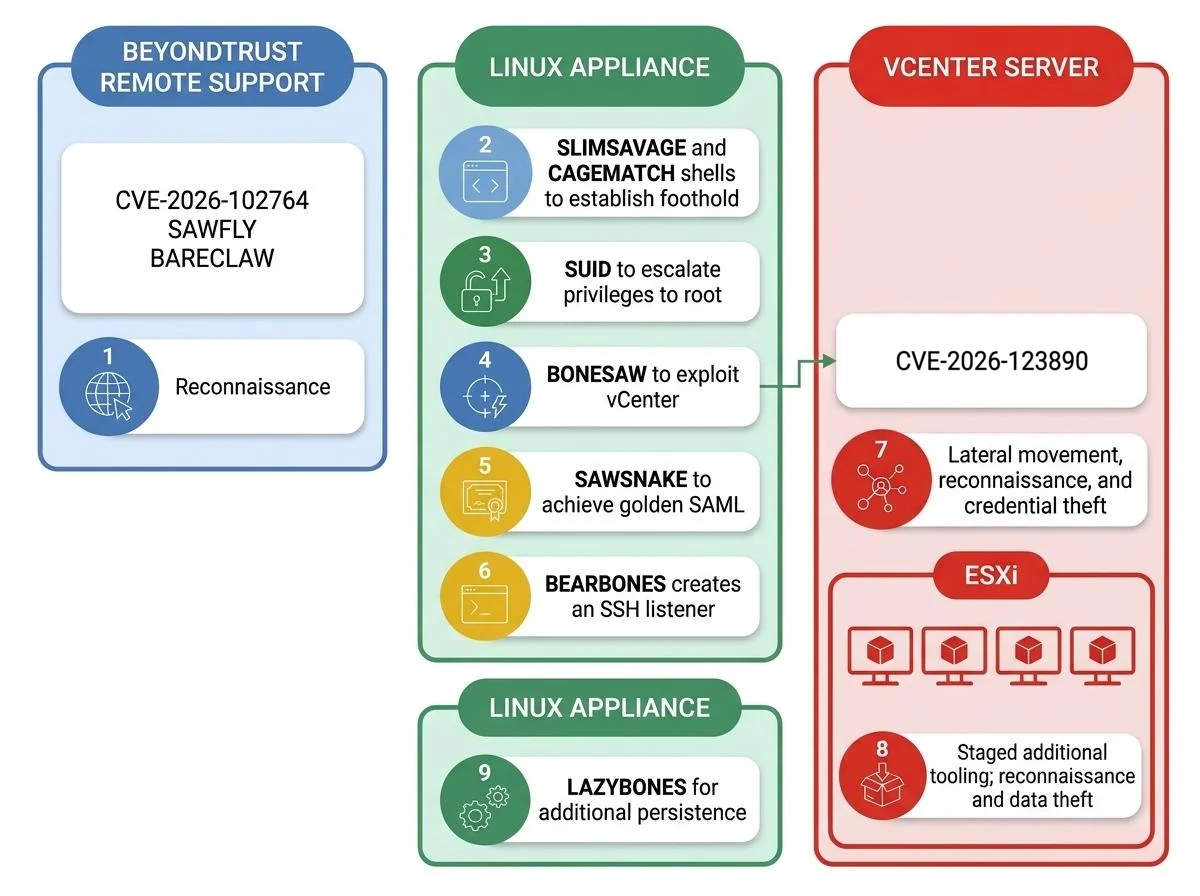
Researchers identified six malware families and utilities used during the campaign: SLIMSAVAGE and CAGEMATCH, JSP web shells for command execution and persistence; BONESAW, for exploiting the vCenter vulnerability; SAWSNAKE, for SAML authentication bypass and Golden SAML attacks, enabling MFA bypass and user impersonation; BEARBONES, a C-based SSH backdoor capable of bypassing password authentication and capturing plaintext credentials; and LAZYBONES, a lightweight Go backdoor using Slack for command-and-control (C2) communications.
Following compromise, attackers created local administrator accounts, enabled SSH access on vCenter appliances, enumerated ESXi file systems, mounted VMFS volumes, and added SSH keys to root accounts. They also collected and archived sensitive data for subsequent exfiltration.
Broadcom addressed CVE-2026-123890 through security patches released on November 19, 2026, covering VMware vCenter Server 7.0 and 8.0, VMware Cloud Foundation, VMware vSphere Foundation, and related Telco Cloud products. Organizations are advised to apply the relevant security updates and investigate potentially compromised VMware infrastructure.
Impact
- Unauthorized Access
- Authentication Bypass
- Command Execution
- Credential Theft
- Privilege Escalation
Indicators of Compromise
CVE
- CVE-2026-123890
- CVE-2026-102764
Remediation
- Apply the latest security patches released by Broadcom to all affected VMware vCenter Server and Cloud Foundation deployments.
- Identify and investigate systems potentially exposed to CVE-2026-123890 and CVE-2026-102764.
- Hunt for BONESAW, SAWSNAKE, BEARBONES, LAZYBONES, SLIMSAVAGE, and CAGEMATCH across VMware and Linux environments.
- Monitor authentication logs for suspicious administrator sessions, unauthorized SSO account creation, and authentication bypass attempts.
- Audit VMware SSO accounts and remove unauthorized administrator accounts and SSH keys.
- Restrict access to VMware management interfaces and disable unnecessary SSH services.
- Monitor network traffic for suspicious DCE/RPC connections, lateral movement, and unauthorized access to VMware-specific ports.
- Inspect ESXi hosts and vCenter appliances for suspicious file modifications, web shells, and persistence mechanisms.
- Monitor outbound traffic for unusual data transfers, file exfiltration, and Slack-based C2 communications.
- Rotate potentially compromised administrator credentials, authentication secrets, and SSH keys.
- Review BeyondTrust Remote Support appliances for indicators of compromise and investigate potential lateral movement.
- Enhance SIEM detection rules to identify suspicious VMware authentication activity, administrative changes, and unauthorized remote access.