

Severity
High
Analysis Summary
Microsoft's official Agent Framework Python package has been compromised on the Python Package Index (PyPI), with two malicious versions, 1.26.1 and 1.26.2, distributing a credential-stealing payload. According to multiple reports, the versions were published 33 minutes apart on November 17, 2026. Both releases have since been quarantined from PyPI.
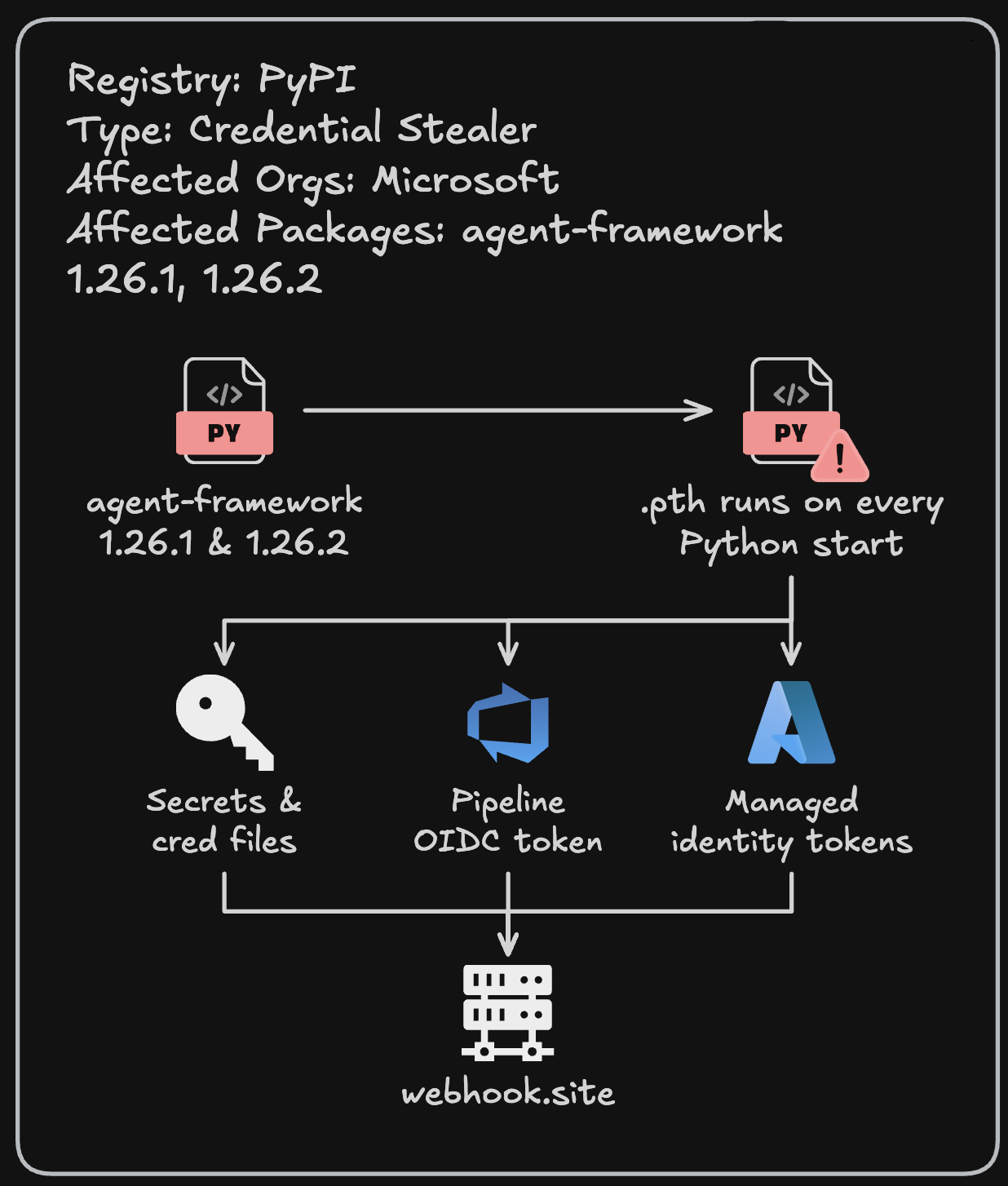
The compromised package is designed to steal sensitive credentials, environment variables, and cloud identity tokens. Upon installation, it drops a malicious .pth file into Python's site-packages directory. Since Python automatically executes import statements within .pth files during interpreter startup, the malicious code runs whenever Python starts, even if the Agent Framework package is never explicitly imported.
The malware targets a wide range of sensitive information, including Azure CLI credentials, .npmrc, .netrc, .git-credentials, Docker configurations, Hugging Face credentials, .env files, and Azure DevOps credentials. It also harvests Azure DevOps and GitHub Actions OIDC tokens, Azure managed identity tokens, and cloud instance metadata. Additionally, the malware can request fresh cloud identity tokens through Azure's managed identity endpoints.
The collected information is consolidated into a JSON document, compressed using zlib, Base64-encoded, and exfiltrated through an HTTPS POST request to a hard-coded webhook[.]site endpoint.
Security researchers have advised organizations to isolate affected hosts and CI/CD runners, downgrade to the last known safe version (1.26.0), and rebuild environments from clean sources. Organizations should also investigate exposure during the affected release window, search DNS and proxy logs for connections to the malicious endpoint, rotate potentially compromised credentials, audit Azure identities, and review GitHub Actions workflows.
The incident highlights growing threats targeting software supply chains and AI development ecosystems. It also marks the second Microsoft-related PyPI compromise in 2026, following the May compromise of Microsoft's durabletask package, which was used to distribute the Mini Shai-Hulud worm.
Impact
- Data Exfiltration
- Credential Theft
- Lateral Movement
- Unauthorized Access
- Supply Chain Compromise
- Sensitive Information Exposure
Indicators of Compromise
IP
178.63.67.106
MD5
548634ffe60848d466acbb9df0e47fb5
9d4ccd936a223d7cab0b308e92454ceb
d4a70785f9351afc9fbada4e33edf891
dc16d2c976abf5a4d08db281fdc0d18b
SHA-256
- d27fa34414e6201d5e03e559ef634f020057554d7b3f4898dd5d7cd3e989e110
- 39fa329f2a93f734b0bb8f5adb203ea3331d1ae479832a5015a54cb17aabd663
- 3d20a8bc91351a9a16b6db243b848ceca0206b7a8623b02d2af553a9c9f7e0a9
- 54d885b7d7161c9ed96489c66364c4bfbf635929166843bba10d97d46b5a2e1f
SHA1
- 7a1eaaec6b325f3cee0c8b328a1b5a285c2f1ad9
- 0a013e4724c4437cf9b177def1d988113e167539
- 921ef8764d3f061184dd4d8de61771b07db11ce9
- e2955eb2718ac8b81695cea89718ebeea525dd59
URL
- https://webhook.site/d381fd80-ec62-42ad-8f5c-d1b15103c9bb?t=telemetry
Remediation
- Identify and remove compromised agent-framework versions 1.26.1 and 1.26.2 from affected systems and Python environments.
- Upgrade or pin the package to the last known safe version (1.26.0) until a verified secure release is available.
- Isolate affected endpoints, development systems, and CI/CD runners to prevent further credential exposure.
- Rebuild compromised Python environments from trusted sources to ensure complete removal of malicious components.
- Hunt for malicious .pth files, including agent_framework_meta.pth and af_runtime_diag.pth, within Python site-packages directories.
- Search DNS, proxy, firewall, and network logs for connections to webhook[.]site and the identified malicious endpoint.
- Rotate potentially exposed credentials, API keys, access tokens, and cloud secrets from clean systems.
- Review Azure managed identities, service principals, and access logs for suspicious authentication and token issuance activities.
- Audit GitHub Actions and Azure DevOps pipelines for unauthorized workflow modifications and suspicious OIDC token requests.
- Monitor endpoint and Python execution logs for suspicious startup hooks, credential harvesting, and unauthorized outbound connections.
- Implement software composition analysis (SCA) and dependency monitoring to detect malicious package versions before deployment.
- Enforce dependency pinning, package integrity verification, and trusted repository policies across development and CI/CD environments.