
Severity
High
Analysis Summary
Recent U.S.-Israeli strikes on Iranian targets, followed by Iranian responses across the region, have created a rapidly evolving geopolitical environment with significant cyber threat implications. Based on historical patterns, Iranian state-aligned and affiliated actors are likely to increase cyber operations as part of a broader response strategy that integrates cyber capabilities with kinetic and information warfare.
Iran maintains a mature cyber ecosystem, leveraging espionage, disruptive attacks, and influence operations to support strategic objectives. Activity associated with groups such as APT34, APT39, APT42, and MuddyWater has historically included credential theft, spearphishing, wiper malware deployment, Distributed Denial-of-Service (DDoS) campaigns, and the use of proxy “hacktivist” personas for plausible deniability. These operations have targeted government, defense, telecommunications, financial, and academic sectors across Israel, the United States, and the wider Middle East.
Recent reporting indicates early-stage cyber mobilization aligned with the current escalation. Pro-Iranian channels are disseminating messaging guidance focused on operational security and narrative control, while multiple hacktivist groups, including “Cyber Islamic Resistance” and “313 Team,” have announced intent to target Israel, the United States, and Gulf Cooperation Council (GCC) countries.
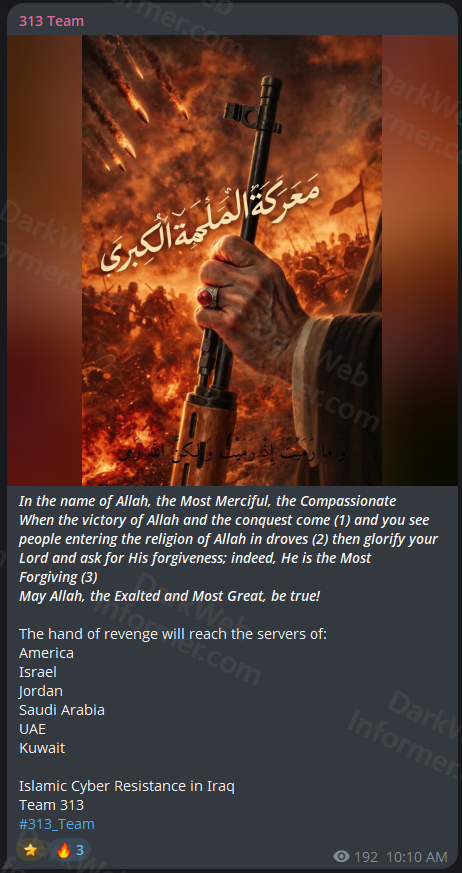
Claims of activity include website defacements, targeting of financial and government platforms, and attempted disruption of defense-related systems such as drone detection infrastructure in Israel and military-linked websites in Kuwait. Additional actors, including “Cyber Isnaad Front,” have also declared intent to target U.S. and Israeli infrastructure.
The emergence of a purported alliance of hacktivist groups suggests potential for coordinated campaigns, although current activity levels remain limited and many claims are unverified, indicating possible elements of information operations.
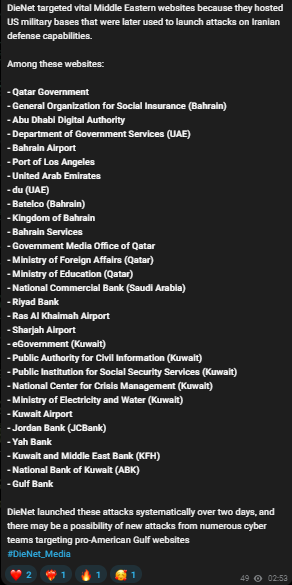
Separate reporting indicates that the group “DieNet” conducted coordinated attacks over a two-day period targeting multiple Middle Eastern government, aviation, telecom, and financial websites, citing their association with U.S. military presence. Affected entities reportedly include government platforms in Qatar, Bahrain, the UAE, and Kuwait, major telecom providers such as du and Batelco, financial institutions across the Gulf, and aviation infrastructure including Bahrain, Sharjah, and Ras Al Khaimah airports, alongside the Port of Los Angeles. The scale and targeting suggest a broad, regionally focused campaign against perceived pro-U.S. infrastructure.
Overall, the threat landscape indicates a high likelihood of increased cyber activity, including espionage, disruptive attacks, and coordinated influence operations, with elevated risk for organizations across the United States, Israel, and allied regions.
Impact
- Distributed Denial of Service
- Website Defacement
- Data Exfiltration
- Sensitive Information Exposer
- Operational Disruption
Remediation
- Enforce multi-factor authentication (MFA) across all critical systems to reduce risk of credential compromise
- Strengthen email security and phishing detection to prevent initial access via social engineering
- Continuously monitor for anomalous login behavior and suspicious account activity
- Apply timely patching of internet-facing systems to eliminate exploitable vulnerabilities
- Implement network segmentation to isolate critical assets and limit lateral movement
- Deploy Endpoint Detection and Response (EDR) to detect and contain malicious activity
- Configure DDoS protection and rate limiting to maintain availability of public services
- Secure and restrict access to ICS/OT environments to prevent operational disruption
- Monitor for abuse of legitimate tools such as PowerShell, scheduled tasks, and tunneling services
- Maintain offline and immutable backups to ensure recovery from destructive attacks
- Encrypt sensitive data and communications to prevent interception and leakage
- Prepare incident response plans and conduct simulations for ransomware and wiper scenarios
- Limit access to critical systems based on least privilege and zero trust principles
- Ensure coordination with national and sectoral CERTs for timely threat sharing