

Severity
High
Analysis Summary
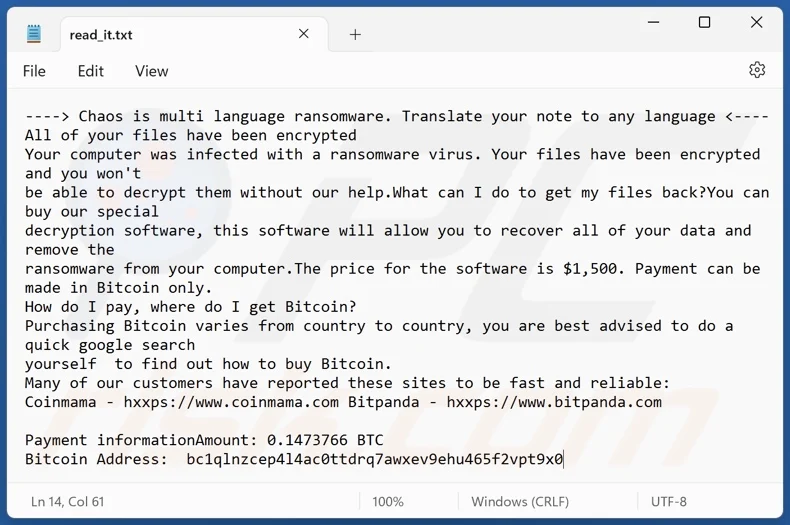
Chaos is a customizable ransomware builder that emerged on June 9, 2021 (in underground forums) by falsely marketing itself as the .NET version of Ryuk despite sharing no such overlaps with the notorious counterpart. Since then, it has undergone active development and quick advancements, which have persuaded several attacker groups to adopt it. The most recent version, Yashma, was observed in the wild in May 2022. Yashma allows attackers to configure the ransomware so that it does not execute depending on the language chosen on the victim's device. It can also disable antivirus software, backup, storage, remote desktop, and credential vault services on victims' machines. Malware developers frequently employ this strategy to avoid infecting computers in their region, which would draw the attention of local law authorities. The Chaos ransomware generator is said to lack still some of the capabilities that are seen in many existing ransomware families.
Chaos Ransomware is a serious threat to individuals and organizations, as it can result in the loss of valuable data and disruption to normal business operations. To protect against Chaos Ransomware and other similar threats, it is recommended that individuals and organizations implement a robust cybersecurity program, including regular software updates, anti-malware protection, and employee training on the dangers of phishing and social engineering.
Impact
- File Encryption
- Financial Loss
Indicators of Compromise
MD5
2cc372097f710c7a6cbb8b4d7f99636e
8536fa1fe6c23759ba25bad70155145d
SHA-256
0a0f1e0ef771046285f78b7af20aac3384b521dbbf6bc69ca6d559cc15d9f97e
c8269b6919b50f1400134e84d343e70c886c024a6e9282463832d81815195897
SHA1
f277abb67529f37f2486bbf4fab7ef107575b755
66ee059092e55be43dc11c67f448ae8467525a30
Remediation
- Block all threat indicators at your respective controls.
- Search for Indicators of compromise (IOCs) in your environment utilizing your respective security controls
- Maintain cyber hygiene by updating your anti-virus software and implementing a patch management lifecycle.
- Maintain Offline Backups - In a ransomware attack, the adversary will often delete or encrypt backups if they have access to them. That’s why it’s important to keep offline (preferably off-site), encrypted backups of data and test them regularly.
- Emails from unknown senders should always be treated with caution.
- Never trust or open " links and attachments received from unknown sources/senders.